

Quick facts about the ASN Bridge Option for paramedics in Birmingham
| Accreditation | ACEN accredited,† Accredited by the Higher Learning Commission |
|---|---|
| Format | Online general education classes + core on-campus courses in Birmingham |
| Finish faster | Take advantage of your current licensure and experience as a paramedic and earn an ASN faster than a traditional pre-licensure program |
| Future pathways | After earning an associate degree, you can potentially apply for our online Accelerated RN to MSN program in the future, which features several options for specialization |
| QuickPaths | Transfer credit, stackable credentials, and adaptive learning technology build a faster pathway to a higher education with Herzing University |
Learn More Today!
Turn your experience in emergency care into a rewarding career in nursing
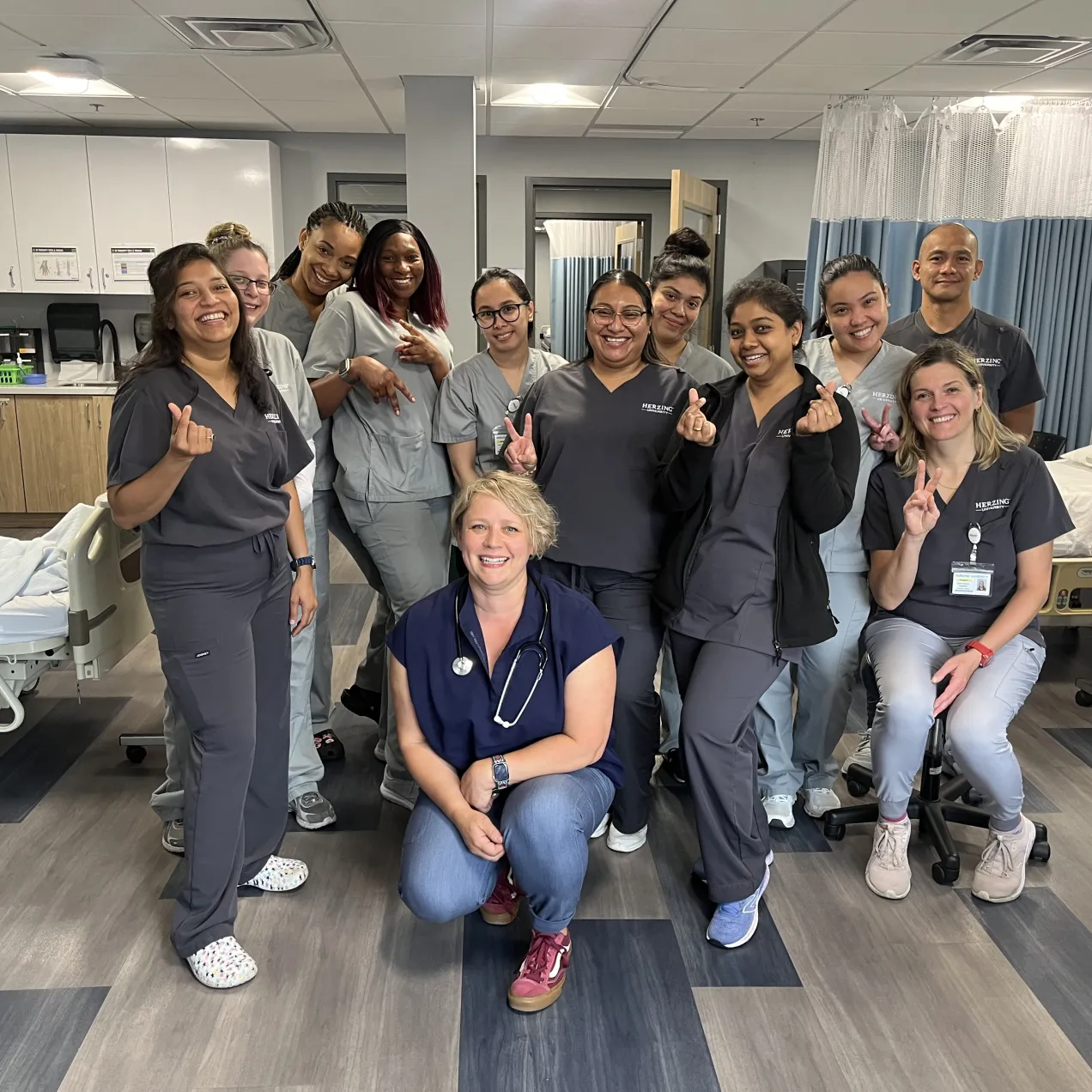
Herzing University’s ASN Bridge Option in Birmingham offers a faster associate degree pathway for paramedics ready to expand their role in healthcare.
This program builds on your real-world experience, helping you strengthen your clinical decision-making and patient care skills across a variety of settings. As you progress, you’ll earn the knowledge and skills required to take on new responsibilities in patient care and prepare to excel as a registered nurse.
With guidance from experienced faculty, you can continue developing your confidence and move forward on a path toward long-term career growth in nursing.
Career-focused curriculum
Discover the crucial knowledge and skills required to succeed in your work and build a foundation for continued career growth.
Flexible schedule
We work hard to help you maintain school-life balance, striving to be as flexible as possible for busy non-traditional students.
Experienced faculty
Get face-to-face instruction from experienced and credentialed faculty with real-world success in the field.
Lifelong support
We support your ongoing career advancement by providing comprehensive, personalized student services with lifelong career coaching.
Rolling admissions
No application deadlines to worry about. Apply when you’re ready and prepare to get started soon.
Classes & curriculum details
The ASN bridge program combines theoretical instruction with real, hands-on training in a variety of clinical settings to provide a broad, holistic and reality-based understanding of the duties of a professional nurse.
The program incorporates online classwork – you may complete general education requirements online. However, much of the core nursing coursework and laboratory experience must be done on campus in Birmingham.
| Program | Months i | Semester Credits |
|---|---|---|
| Associate of Science in Nursing - Bridge Option | 20 | 72 |
i. Average number of months for students to complete program.
Required Courses in Nursing
33.00 semester credit hours are required.
Required Courses in General Education
Students enrolled in this associate degree program must complete a minimum of 26.00 semester credit hours. 6.00 Semester Credit Hours in Communications EN 104 English Composition I EN 111 Information Literacy 3.00 Semester Credit Hours in Humanities HU 140 Cultural Diversity 3.00 Semester Credit Hours in Mathematics MA 109 College Algebra 3.00 Semester Credit Hours in Behavioral Science PS 105 Developmental Psychology 11.00 Semester Credit Hours in Science SC 154 Anatomy and Physiology I for Nurses SC 166 Microbiology SC 254 Anatomy and Physiology II for Nurses Courses transferred from other accredited colleges may also be used to meet these requirements. Science courses being transferred from other accredited colleges must meet the nursing program science requirements.
Special General Education Grading Requirements
The following general education courses must be completed with a grade of "C" (70%) or better for a student to continue in the nursing program. MA 109 College Algebra PS 105 Developmental Psychology SC 166 Microbiology The following science courses must be completed with a grade of "B" (80%) or better. Only two attempts are permitted for each course and a student who fails to successfully complete in the maximum attempts is subject to dismissal from the nursing program. SC 154 Anatomy and Physiology I for Nurses SC 254 Anatomy and Physiology II for Nurses A student who is dropped from the nursing program for failing to achieve the minimum grade specified in the courses listed above, but who otherwise meets the academic standards of the University may transfer to another Herzing degree program and/or may appeal to reapply to the ASN nursing program in a future semester. Resuming students should refer to the section on re-entering for additional requirements.
Distribution of Contact Hours by Course
Distribution of Contact Hours by Course Course or Category Lecture Lab Clinical Total Contact Hours Credits Block Credit Transfer 195.00 0.00 0.00 195.00 13.00 NSG 124 45.00 0.00 0.00 45.00 3.00 NSG 126 15.00 30.00 45.00 90.00 3.00 NSG 221 45.00 0.00 45.00 90.00 4.00 NSG 222 60.00 0.00 90.00 150.00 6.00 NSG 223 60.00 0.00 90.00 150.00 6.00 NSG 233 45.00 30.00 45.00 120.00 5.00 NSG 291 15.00 0.00 90.00 105.00 3.00 NSG 298 45.00 0.00 0.00 45.00 3.00 SC 154 45.00 30.00 0.00 75.00 4.00 SC 254 45.00 30.00 0.00 75.00 4.00 SC 166 30.00 30.00 0.00 60.00 3.00 Communication 90.00 0.00 0.00 90.00 6.00 Humanities 45.00 0.00 0.00 45.00 3.00 Mathematics 45.00 0.00 0.00 45.00 3.00 Social or Behavioral Science 45.00 0.00 0.00 45.00 3.00 Totals 870.00 150.00 405.00 1425.00 72.00
Accreditation
Our accredited ASN Bridge program option for paramedics
We strive to earn rank as one of the top private, nonprofit universities in the United States. Just as you work every day to become the best version of yourself, so do we as a university.
We are proud to have attained institutional accreditation, as well as programmatic accreditation for our ASN Bridge Options for licensed paramedics in Birmingham.
✝The associate in nursing program at Herzing University – Birmingham located in Birmingham, Alabama is accredited by the: Accreditation Commission for Education in Nursing (ACEN) 3390 Peachtree Road NE, Suite 1400 ǀ Atlanta, GA 30326 (404) 975-5000. The most recent accreditation decision made by the ACEN Board of Commissioners for the associate of science in nursing program is initial accreditation. View the public information disclosed by the ACEN regarding this program on the ACEN website.
Herzing University is institutionally accredited by the Higher Learning Commission (hlcommission.org), an institutional accreditor recognized by the U.S. Department of Education.
Enrollment requirements
To be considered for admission into the ASN Bridge program option for paramedics in Birmingham, you must hold a high school diploma or equivalent (Diploma, HSED or GED) and meet the following criteria based on your cumulative GPA:
| Cumulative GPAi | Science Requirement | TEASii |
|---|---|---|
| 3.50–4.00 | None | None |
| 3.00–3.49 | 3.00 GPA in college scienceiii | None |
| 2.50 and higher | None | Composite TEAS of 58 |
i. Students with 18 or more transferable collegiate credits will be assessed on their collegiate cumulative GPA. Otherwise, the high school GPA will be used.
ii. The Test of Essential Academic Skills (TEAS) from the Assessment Technology Institute (ATI).
iii. Based on your cumulative GPA in these college science courses: Anatomy & Physiology I and II, Biology, Chemistry, and Microbiology. Two of these courses must be used to calculate science GPA. Any of these courses completed must be included in the calculation, and no others. If you do not meet this requirement, you must score a composite score of 58 or higher on the TEAS. A grade of "B" or better must be earned for transfer credit to be awarded for Anatomy & Physiology, regardless of whether it was included in the calculation.
Waived Enrollment Fee
Discover the educational pathway designed to maximize your career potential. Reach for greater heights with Herzing University.


Going from paramedic to RN

Pursuing the RN career path means transitioning from working as a first responder to becoming a crucial contributor to ongoing care once the patient reaches the hospital (or other medical facility).
As a registered nurse you’ll be the backbone of day-to-day operations in many healthcare settings. RNs help to:
- Develop and direct treatment plans
- Counsel patients and family members
- Ensure patient comfort
- Serve as the key connection between doctors and patients
Registered Nurse ranks as the #18 Best Healthcare Job for 2025 according to U.S. News & World Report.
Can I specialize? RNs can specialize in an area of their choosing with enough education and experience. You may be able to use your experience as a paramedic to help become an emergency/ER nurse in the future.
Job outlook and pay potential
According to the Bureau of Labor Statistics, employment of registered nurses is expected to increase 6% from 2025-2035.*
Registered nurses earn an average salary of $101,420 per year ($48.76 per hour). That would represent a significant raise for the average paramedic in the US ($49,500 per year, $23.80 per hour).
You can take a big step forward in your nursing career by becoming an RN.
Related Programs


The Student Experience at Herzing
I learned that sacrifices are sometimes needed to achieve your goals. But I am now living my dream and couldn't be more thankful!
Morgan Dodd
Nursing | Akron CampusWhen it comes to hands-on learning, though, nothing quite beats clinicals!
Phoebe Phypers
Nursing | Orlando CampusI’m looking forward to the future! If there is any advice I have to give to students, it’s to be sure to study hard and with a partner!
Ijeoma Okolo
Nursing | Online CampusDon’t give up and hang in there! Perseverance is the key to success!
Ericka Watson-Polk
Nursing | Online CampusI would not be where I am today without the help of Herzing!
Valerie Ketterhagen
Nursing | Madison CampusDisclosures
The Associate of Science in Nursing program at Herzing University - Birmingham is approved by the Alabama Board of Nursing (RSA Plaza, 770 Washington Avenue, Suite 250, Montgomery, Alabama, 36104, 334-293-5200, www.abn.alabama.gov). Upon completion of the program, graduates are eligible to apply to the State Board of Nursing to sit for the National Council of State Boards of Nursing (NCLEX-PN) licensing exam.
Herzing University Birmingham Nursing Student Handbook
| Program | 2025 Completion Ratei | 2025 NCLEX-RN/NCLEX-PN Pass Rateii |
|---|---|---|
| Akron Campus: Associate of Science in Nursing | 26.76% | 84.91% |
| Birmingham Campus: Practical Nursing | 23.57% | 97.96% |
| Birmingham Campus: Associate of Science in Nursing | 40.63% | 89.87% |
| Brookfield Campus: Practical Nursing | 29.63% | 80.39% |
| Kenosha Campus: Practical Nursing | 23.08% | 92.86% |
| Madison Campus: Practical Nursing | 14.58% | 100% |
| Madison Campus: Associate of Science in Nursing | 58.70% | 75% |
| Nashville Campus: Practical Nursing | 25.32% | 100% |
| Nashville Campus: Associate of Science in Nursing | 33.33% | 64.29% |
| Orlando Campus: Practical Nursing | 38.53% | 82.29% |
| Orlando Campus: Associate of Science in Nursing | 31.82% | 76.47% |
| Tampa Campus: Practical Nursing | 21.70% | 93.75% |
| Tampa Campus: Associate of Science in Nursing | 27.87% | 83.87% |
iIn accordance with ACEN requirements, program completion rate is the calculation of the percentage of students who enter the program of study and complete the program of study in the advertised program length (i.e., on-time). Calculation of the program complete rate begins with a student’s enrollment in the first nursing course and at the time when a student can no longer receive a 100% tuition refund for the first nursing course, regardless of the source of funds used to pay the students’ tuition. The calculation ends with students’ completion of all requirements for conferral of a certificate, diploma, or degree, as appropriate.
iiRates reflect the performance of graduates who took the NCLEX® for the first time between January 1 and December 31. This excludes the Birmingham Campus programs, which report NCLEX® pass rates based on all test attempts for graduates testing between January 1 and December 31, in accordance with Alabama Board of Nursing requirements.
The Clarksville Campus is a satellite location of the Nashville Campus. Therefore, completion and NCLEX® pass rates are aggregated for these two campus locations.
* BLS pay estimates calculate the median annual wage for various occupations. Per the BLS the median wage for an occupation is: "The wage at which half of the workers in the occupation earned more than that amount, and half earned less. Median wage data are from the BLS Occupational Employment and Wage Statistics survey." Bureau of Labor Statistics (BLS), U.S. Department of Labor, Occupational Outlook Handbook 2025. BLS median wage estimates do not represent entry-level wages and/or salaries. Multiple factors, including prior experience, age, geographic market in which you want to work, and degree level and field, will affect career outcomes, including starting salary and earnings as an experienced employee. Herzing neither represents that its graduates will earn the median salaries calculated by BLS for a particular job nor guarantees that graduation from its program will result in a job, promotion, particular wage or salary, or other career growth.
Recent Blog Posts




Waived Enrollment Fee
Discover the educational pathway designed to maximize your career potential. Reach for greater heights with Herzing University.