

Bridge from sterile processing to surgical technology with Herzing University
| Accreditation | CAAHEP accredited,† Accredited by the Higher Learning Commission |
|---|---|
| Format | Accelerated, hybrid delivery: online didactic courses + on-campus labs and on-site clinicals |
| Locations | Available in Louisiana; on-campus labs take place at our New Orleans, LA (Separate Instructional Site) campus location |
| Eligibility | Diploma in Sterile Processing or equivalent program required; applicants with no prior sterile processing education may apply for our Direct Entry/Traditional Option |
| QuickPaths | Transfer credit, stackable credentials, and adaptive learning technology build a faster pathway to a higher education with Herzing University |
Learn More Today!

Satisfaction rate
Our overall student satisfaction rate, according to the 2025 Herzing Graduate Survey.
From sterile processing to surgical tech: accelerate to the next level with Herzing University
The Associate of Science in Surgical Technology – Bridge program option is designed for sterile processing professionals ready to take the next step toward the operating room. Building on your existing knowledge and experience, the program helps you expand your skills and prepare for new responsibilities in surgical settings.
Through a hybrid format, you’ll complete coursework online while strengthening your abilities in hands-on lab environments and clinical settings. You’ll focus on sterile technique, instrumentation, surgical procedures, intraoperative support, and much more.
This program offers an accelerated pathway to grow your experience and build practical, job-relevant skills as you prepare to pursue opportunities as a surgical technologist.

Career-focused curriculum
Discover the crucial knowledge and skills required to succeed in your work and build a foundation for continued career growth.
Find your balance
Hybrid delivery helps you maintain school-life balance, designed to be as flexible as possible for busy non-traditional students.
Virtual services
Access to extensive virtual services, including academic advising, tutoring, support services, technical support and library services.
Lifelong support
We support your ongoing career advancement by providing comprehensive, personalized student services with lifelong career coaching.
Courses & curriculum details
You’ll move through a structured learning experience designed to help you build knowledge, practice skills, and gain real-world experience. You’ll begin with academic coursework covering core surgical technology topics, as well as any needed gen eds.
Next, you’ll apply what you’ve learned in on-campus labs at the New Orleans Campus. These hands-on sessions introduce techniques in a controlled environment, helping you build confidence before entering a clinical environment.
The program culminates in 405 hours of supervised clinical training across three courses. You’ll observe procedures, assist surgical teams, and gradually take on more responsibility as you develop the skills needed to perform in a surgical setting.
Special gen ed grading requirements. You must achieve a “B” (80%) or better in no more than two attempts of Anatomy & Physiology I, A&P II, and Microbiology to continue in the program.
| Program | Months i | Credits |
|---|---|---|
| Associate of Science in Surgical Technology - Bridge Option | 16 | 60 |
i. Average number of months for students to complete the program attending full-time
Required Courses
All courses, 33.00 semester credit hours, are required.
Special Grading Requirements for Surgical Technology Courses
All surgical technology courses must be completed with a grade of "C" (76%) or better in no more than two attempts for a student to be continued in the Surgical Technology program.
Required Courses in General Education
Students enrolled in this associate degree must complete a minimum of 26.00 semester credit hours in general education distributed among the following disciplines. The Herzing University General Education offerings are listed below. Refer to the General Education section of this catalog for Herzing University courses that would satisfy these requirements. 6.00 Semester Credit Hours in Communications EN 104 English Composition I EN 111 Information Literacy 3.00 Semester Credit Hours in Humanities HU 140 Cultural Diversity 3.00 Semester Credit Hours in Mathematics MA 109 College Algebra 11.00 Semester Credit Hours in Science SC 146 Anatomy and Physiology I SC 166 Microbiology SC 246 Anatomy and Physiology II 3.00 Semester Credit Hours in Social and Behavioral Sciences PS 101 Psychology
Special General Education Grading Requirements for Surgical Technology Support Courses
The following general education courses must be completed with a grade of "B" (80%) or better in no more than two attempts for a student to be continued in the Surgical Technology program: SC 146 Anatomy and Physiology I SC 166 Microbiology SC 246 Anatomy and Physiology II All other general education courses must be passed with a grade of "D" (60%) or better to be continued in the Surgical Technology program. A student who is dropped from the program for failing to achieve the minimum grade specified in the general education courses, but who otherwise meets the academic standards of the University, may transfer to another Herzing degree program
Personal and Professional Development Courses
1.00 semester credit hour is required.
Distribution of Contact Hours by Course
Distribution of Contact Hours by Course Course Lecture Hours Lab Hours Clinical Hours Total Contact Hours Credits HC 101 15.00 0.00 0.00 15.00 1.00 ST 115 30.00 0.00 0.00 30.00 2.00 ST 120 30.00 30.00 0.00 60.00 3.00 ST 125 15.00 30.00 0.00 45.00 2.00 ST 130 45.00 0.00 0.00 45.00 3.00 ST 138 30.00 0.00 0.00 30.00 2.00 ST 140 45.00 0.00 0.00 45.00 3.00 ST 205 0.00 90.00 0.00 90.00 3.00 ST 215 0.00 90.00 0.00 90.00 3.00 ST 225 0.00 0.00 135.00 135.00 3.00 ST 235 0.00 0.00 135.00 135.00 3.00 ST 248 0.00 0.00 135.00 135.00 3.00 ST 255 30.00 0.00 0.00 30.00 2.00 PD 202 15.00 0.00 0.00 15.00 1.00 Gen Ed - Communications 90.00 0.00 0.00 90.00 6.00 Gen Ed – Humanities 45.00 0.00 0.00 45.00 3.00 Gen Ed – Mathematics 45.00 0.00 0.00 45.00 3.00 Gen Ed - Science 120.00 90.00 0.00 210.00 11.00 Gen Ed – Social and Behavioral Sciences 45.00 0.00 0.00 45.00 3.00 Totals 600.00 330.00 405.00 1335.00 60.00
Location
State eligibility
The hybrid Surgical Technology Bridge program option is offered through the Online Campus, with eligibility for students in Louisiana. Students enrolled in this program will complete the theory component of the program online, the laboratory component at the New Orleans Campus (Separate Instructional Site), and clinicals in the State of Louisiana1:
Louisiana
Surgical Technology Bridge Option
Separate Instructional Site
Louisiana residents may apply; labs take place at our New Orleans campus.
Herzing University - New Orleans
3900 North Causeway Blvd Suite 800
Metairie, LA 70002
(504) 613-4295
Admissions requirements
The following general factors are considered prior to acceptance into the Herzing University Surgical Technology – Direct Entry/Traditional option:
- Prior education requirement. Applicants must have earned a Diploma in Sterile Processing or program equivalent.
- Entrance testing. Applicants must achieve a minimum score of 65 on the HESI A2 entrance exam.
- Special criteria. Because the program includes direct patient contact in a clinical setting, you must complete drug testing, immunization and health checks, and accept and acknowledge select statements of policy – contact admissions for more details.
- Availability of time, personal commitment, and a professional attitude. We exist to help enthusiastic students fully committed to reaching their highest career goals. Our Surgical Technology faculty and leadership are dedicated to helping you reach them.
You will need to meet and interview with a Herzing University admissions advisor and complete an enrollment application to be admitted into the program.
If you have any additional questions regarding admissions into the program, please contact our admissions team.
What you need to know about transitioning from sterile processing to surgical technology
1. You’re building on a strong foundation
Your experience in sterile processing gives you a valuable understanding of instrumentation, sterilization, and workflow. This knowledge can help support a smoother transition into the operating room environment.
2. Your responsibilities expand in the OR
As a surgical technologist, your responsibilities grow to include setting up sterile fields, passing instruments, and supporting the surgical team during procedures. You become more directly involved in patient care during surgery.
3. Hands-on skills become even more critical
While you may already be familiar with instruments, you’ll develop additional technical skills through lab practice and clinical experience. These include sterile field management, surgical case flow, and intraoperative support.
4. Professional expectations grow in the OR
Fitting clinical hours into an already hectic life can be a challenge. In collaboration with your clinical preceptor, you will identify a schedule that works best for you.
5. Your earning potential can increase
Advancing into surgical technology may lead to higher earning potential compared to jobs in sterile processing. According to the Bureau of Labor Statistics (BLS), the average salary for surgical technologists nationwide is $68,710 per year ($33.03 per hour).*
Accreditation
Our accredited Surgical Technology program
We strive to earn rank as one of the top private, nonprofit universities in the United States. Just as you work every day to become the best version of yourself, so do we as a university.
We are proud to have attained institutional accreditation, as well as programmatic accreditation for our Surgical Technology program.

✝The Associate of Science in Surgical Technology program at Herzing University Madison is accredited by the Commission on Accreditation of Allied Health Education Programs (www.caahep.org) upon the recommendation of the Accreditation Review Council on Education in Surgical Technology and Surgical Assisting (ARC/STSA). 9355 113th St N, #7709, Seminole, FL 33775, 727-210-2350. Consequently, graduates are eligible to take the certified surgical technologist (CST) examination offered by The National Board of Surgical Technology and Surgical Assisting. Herzing University is approved to offer programs in an online learning modality through association with the main campus in Madison, Wisconsin.
Herzing University is institutionally accredited by the Higher Learning Commission (hlcommission.org), an institutional accreditor recognized by the U.S. Department of Education.
Waived Enrollment Fee
Discover the educational pathway designed to maximize your career potential. Reach for greater heights with Herzing University.
Related Programs




The Student Experience at Herzing
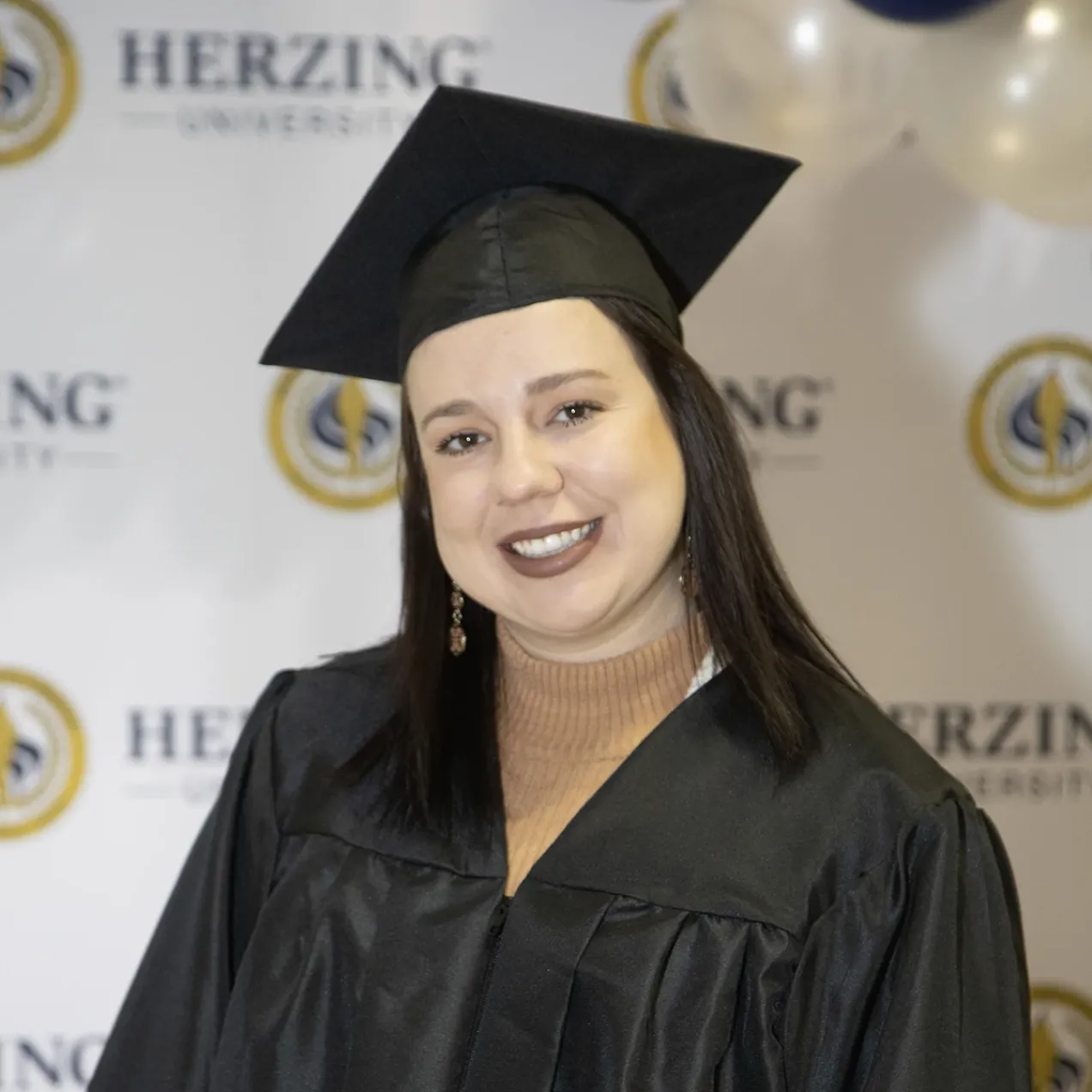
I was inspired to go to Herzing because of the real-world skills they provide. I firmly believe you need these skills to increase your job opportunities and income after graduation, so this was a huge factor in my decision.
Jhalia Samuel
Healthcare | Online CampusEveryone here drove me to do my best and molded me into a better person.
Kayla Glass
Healthcare | Online CampusEven though I’ve been out of school for 25 years, I’ve always been interested in medical coding. This is why I ultimately decided to return to school and began searching for places to attend.
Kelli Freeman
Healthcare | Online CampusI initially chose to get my degree in Surgical Technology because I’ve always watched and enjoyed surgical shows. I knew they were different from working in real life, but they gave me the initiative to try. After the first surgery I scrubbed in on, I knew that I had made the right decision coming here. I was so comfortable and felt like I was exactly where I wanted to be.
Dakota Stamant
Healthcare | New Orleans CampusIf any future students are reading this, here’s some advice: don’t give up!
Brianna Allen
Healthcare | Online CampusDisclosures
- Herzing University is approved to offer programs in an online learning modality through association with the main campus in Madison, Wisconsin.
* BLS pay estimates calculate the median annual wage for various occupations. Per the BLS the median wage for an occupation is: "The wage at which half of the workers in the occupation earned more than that amount, and half earned less. Median wage data are from the BLS Occupational Employment and Wage Statistics survey." Bureau of Labor Statistics (BLS), U.S. Department of Labor, Occupational Outlook Handbook 2025. BLS median wage estimates do not represent entry-level wages and/or salaries. Multiple factors, including prior experience, age, geographic market in which you want to work, and degree level and field, will affect career outcomes, including starting salary and earnings as an experienced employee. Herzing neither represents that its graduates will earn the median salaries calculated by BLS for a particular job nor guarantees that graduation from its program will result in a job, promotion, particular wage or salary, or other career growth.
Waived Enrollment Fee
Discover the educational pathway designed to maximize your career potential. Reach for greater heights with Herzing University.