
Program availability
Your Preferences
Update your Zip code, preferred campus, and preferred program
Your Guide to Sterile Processing Technician Certification
Wondering what certifications are available if you're a central service technician? Learn about the CSPDT and CRCST certifications, including what they offer.

How to get certified as a sterile processing technician
Central service technicians play an important role in preventing infection by carefully cleaning, disinfecting, inspecting, packaging, and sterilizing medical instruments and surgical trays. They are a primary line of defense against healthcare-associated infections (HAIs), protecting patient safety before a surgeon ever picks up a scalpel.
If you’re exploring an entry-level healthcare career with high demand and strong advancement potential, understanding the sterile processing certification landscape – and comparing the two primary credentialing options – is the best way to start your journey.
Understanding sterile processing certification options
In the healthcare industry, national certification serves as proof that a technician possesses essential knowledge of infection control, microbiology, decontamination procedures, and medical device processing. Earning a credential demonstrates your professional competency to employers.
There are two primary credentials for central service technicians:
- Certified Sterile Processing and Distribution Technician (CSPDT) – administered by the Certification Board for Sterile Processing and Distribution (CBSPD).
- Certified Registered Central Service Technician (CRCST) – administered by the Healthcare Sterile Processing Association (HSPA), formerly known as IAHCSMM.
Both certifications are nationally recognized and demonstrate a tech’s mastery of industry standards set by organizations like OSHA, the CDC, and ANSI/AAMI. However, they differ in their eligibility requirements, clinical hour prerequisites, exam structure, and recertification pathways.
Comparing the two pathways: CSPDT vs. CRCST
What is the CSPDT credential?
The CSPDT is a nationally recognized industry credential administered by the Certification Board for Sterile Processing and Distribution (CBSPD). It verifies that a technician possesses the foundational technical knowledge, infection control expertise, and practical competencies necessary to reprocess, package, sterilize, and manage medical tools and surgical equipment.
What does the CSPDT exam cover?
The CSPDT certification exam evaluates expertise across eight core areas:
- Decontamination and disinfection: Manual cleaning methods, mechanical washers/ultrasonic cleaners, enzymatic detergents, personal protective equipment (PPE) protocols, and handling biohazardous equipment.
- Preparation and packaging: Inspecting surgical tools for damage, testing functionality, assembling tray sets, and utilizing proper packaging or rigid container systems.
- Sterilization processes: Operating and monitoring steam, ethylene oxide (EtO), hydrogen peroxide gas plasma, and other low-temperature sterilization systems while analyzing biological and chemical indicators.
- Roles and responsibilities: Standard operating procedures, interdepartmental communication, safety protocols, and scope-of-practice boundaries.
- Sterile storage, inventory management, and distribution: Transporting sterile supplies, managing stock rotation, case cart assembly, and maintaining temperature, humidity, and airflow-controlled storage environments.
- Life science: Basic microbiology, chain-of-infection concepts, and human anatomy related to surgical instrumentation.
- Patient care equipment: Cleaning, high-level disinfection, and testing of reusable non-surgical equipment before redistribution.
- Ethics: Professional conduct expectations, patient confidentiality, and reporting safety or ethical violations.
How do you qualify for the CSPDT exam?
To take the CSPDT exam, you must have a high school diploma or GED and complete a sterile processing training program. You can take your exam as soon as you graduate. You can also qualify by having 12 months of experience in full-time sterile processing or allied health work.
The CSPDT credential is valid for 5 years. Technicians maintain certification through continuing education units (CEUs).
What is the CRCST credential?
The CRCST is a national industry credential administered by the HSPA. It validates that the central services tech possesses the fundamental technical knowledge, infection control expertise, and practical skills required to work in a sterile processing setting.
The CRCST credential covers five core areas:
- Decontamination and disinfection
- Preparation and packaging
- Sterilization processes
- Storage and distribution
- Quality assurance and safety standards
What are the eligibility requirements for the CRCST certification exam?
To earn full CRCST certification, candidates must satisfy both requirements: an assessment exam and a hands-on clinical training component set by the HSPA.
There are two pathways to certification:
- Full CRCST certification: For this, you will need a high school diploma or equivalent and 400 hours of hands-on experience during the five years preceding the application.
- Provisional CRCST certification: This requires candidates to have a high school diploma or equivalent and complete 400 hours of hands-on experience within six months after passing the certification exam.
Your supervisor or clinical coordinator must verify your qualifications and hours across the following areas:
- Decontamination: 120 hours
- Preparing and packaging instruments: 120 hours
- Sterilization and disinfection: 120 hours
- Storage and distribution: 24 hours
- Quality assurance processes: 16 hours
Once certified, technicians must meet renewal requirements annually, which often include completing continuing education (CE) credits or continuing education units (CEUs) to keep current with industry standards.
Herzing University’s online Sterile Processing Program
If you’re looking for schools to help you prep for the CSPDT or CRCST exam, entry-level technician roles, or career readiness, check out Herzing University’s online Diploma in Sterile Processing.
The Diploma in Sterile Processing (DSP) program is a fully online program that can be completed in as few as 10 months. Coursework covers essential topics such as medical terminology, microbiology, decontamination, sterilization, infection prevention, and sterile processing standards. Students engage in virtual labs and simulations, along with at-home activities to reinforce foundational concepts.
The curriculum is designed to prepare students for careers in sterile processing and support their preparation for industry certification exams, including the HSPA Certified Registered Central Service Technician (CRCST) exam and the CBSPD Certified Sterile Processing and Distribution Technician (CSPDT) exam. Please note that HSPA's full CRCST certification requires 400 hours of hands-on sterile processing experience, which is not provided through the DSP program.
Waived Enrollment Fee
Discover the educational pathway designed to maximize your career potential. Reach for greater heights with Herzing University.
Frequently Asked Questions
Earning your CSPDT or CRCST certificate offers many benefits:
- State and health system mandates: An increasing number of states and hospital networks require sterile processing staff to obtain professional certification either prior to employment or within a specified window after hiring.
- Competitive advantage: According to the Bureau of Labor Statistics,* employment of medical equipment preparers is expected to grow 13% from 2025-2035, faster than the average across all U.S. occupations.* Earning your CSPDT or CRCST cert can help you demonstrate your competency and stand out to employers when applying for jobs.
- Career mobility: Earning your certification paves the way for you to become a specialized technologist or earn advanced credentials like Certified Instrument Specialist (CIS) or Certified Healthcare Leader (CHL). It also provides a strong foundation for taking on management roles or pursuing future careers in healthcare, such as surgical technology.
Central service technicians, also called sterile processing (SPT) techs or central service (CS) professionals, work behind the scenes in a sterile processing department (known as an SPD or CSPD), preparing surgical instruments and med devices.
Sterile processing involves cleaning medical supplies and preparing them to be used again. This process includes cleaning, inspecting, sterilizing, storing, and delivering medical devices, ensuring doctors can operate safely on patients without risking infection.
Central service techs perform five key duties:
- Clean and disinfect: Carefully clean used surgical tools and medical or dental devices using strong cleaning products and manual and mechanical techniques.
- Inspect: Check instruments for damage to ensure they function properly.
- Sterilize: Operate and monitor machines like autoclaves to eliminate all microorganisms.
- Assemble: Organize and wrap sterilized instrument sets and trays for specific surgeries and store for later use.
- Distribute: Manage sterile storage areas and deliver supplies to operating rooms, patient care units, and other related services.
Central service technicians typically work in hospitals, healthcare clinics, outpatient facilities near surgical centers, and nursing homes and assisted living facilities. They work behind the scenes and have little to no direct contact with patients.
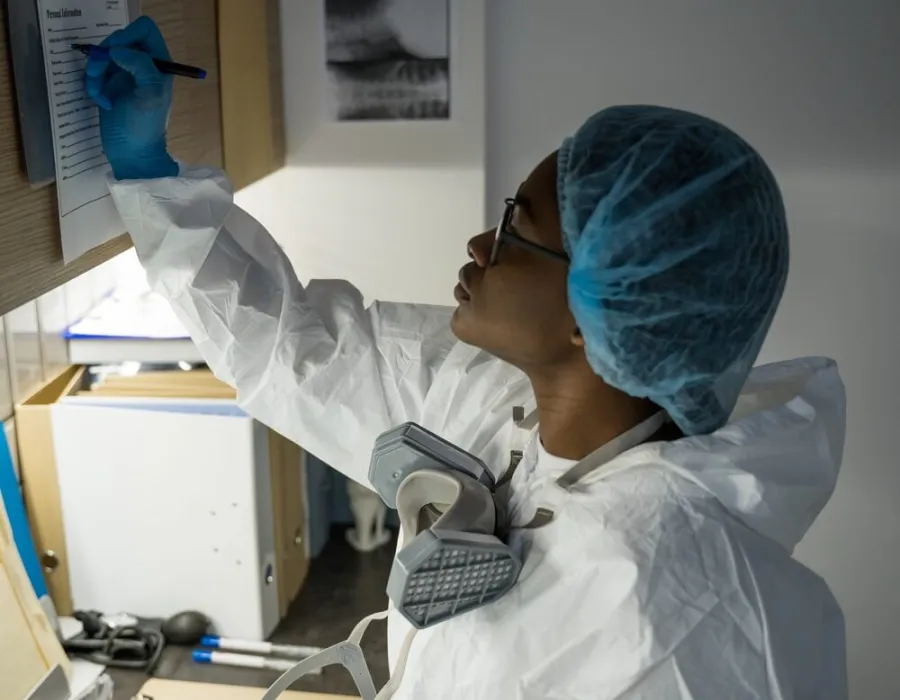
Because they may be exposed to biohazardous materials like blood as well as strong cleaning supplies, central service technicians must wear personal protective equipment (PPE), including gloves, gowns, and face masks.
There are many benefits to enrolling in a sterile processing training program. One study evaluated a 10- to 13-week sterile processing technician training program using a competency-based framework with didactic instruction and clinical practice. The program reported a 95.65% completion rate, while 80.95% of completers who applied for the CRCST exam passed.
Additionally, academic credits earned in Herzing’s Sterile Processing program can potentially transfer directly into higher-level programs, such as Herzing's Associate Degree in Surgical Technology, helping you earn your degree faster.
Herzing University also offers many affordable financial aid opportunities to help manage tuition costs, including scholarships, grants, loans, VA and military benefits, and free aid counseling.
Start your online sterile processing program today!
Earning your certified sterile processing credential isn't just about launching a high-demand healthcare career – it’s about playing a critical role in patient safety. Every clean instrument and sterile tray directly impacts a successful surgery and a patient's recovery.
If you're ready to step into a rewarding career where you can truly make a life-saving difference, take the first step toward a career in sterile processing and learn more about your educational options today.
Learn about Herzing's Sterile Processing Program
* BLS pay estimates calculate the median annual wage for various occupations. Per the BLS the median wage for an occupation is: "The wage at which half of the workers in the occupation earned more than that amount, and half earned less. Median wage data are from the BLS Occupational Employment and Wage Statistics survey." Bureau of Labor Statistics (BLS), U.S. Department of Labor, Occupational Outlook Handbook 2025. BLS median wage estimates do not represent entry-level wages and/or salaries. Multiple factors, including prior experience, age, geographic market in which you want to work, and degree level and field, will affect career outcomes, including starting salary and earnings as an experienced employee. Herzing neither represents that its graduates will earn the median salaries calculated by BLS for a particular job nor guarantees that graduation from its program will result in a job, promotion, particular wage or salary, or other career growth.