
Program availability
Your Preferences
Update your Zip code, preferred campus, and preferred program
What Can You Do with an Associate Degree in Radiologic Technology?
Are you wondering what options you have with an associate in radiologic technology? Learn about the specializations you can pursue with this degree.
Your Options with an Associate Degree in Radiologic Technology
An associate degree in radiologic technology is one of the shorter routes into hands-on clinical work. That clinical work is more varied than people imagine. Usually, if you ask people what a radiologic technology degree prepares you to do, there's just one answer: “Take x-rays.”
The truth is that taking x-rays is just the starting point. Earning your Associate of Science in Radiologic Technology with Herzing can open the door to computed tomography (CT), magnetic resonance imaging (MRI), sonography, interventional and cardiovascular radiology, bone densitometry, mammography, radiation therapy, medical dosimetry, and more. One two-year degree can set the foundation to prepare you for up to a dozen imaging disciplines as your career progresses.
Job openings for rad tech graduates look healthy, too. The U.S. Bureau of Labor Statistics (BLS) projects that employment of radiologic technologists and technicians will grow 5% from 2025-2035, faster than the 3% average for all occupations, and projects about 11,800 openings for these roles each year over the decade.*
This article walks through what our degree covers, what radiographers do day to day and the specializations you can pursue after graduation.
What You Learn in Herzing’s Associate Degree Program
Radiologic technologists need to understand physics, anatomy, medical terminology and patient care skills. Our program establishes a general education foundation, then builds on it with radiological theory, practice in our labs and 700+ hours of supervised clinical practice in working healthcare facilities. Selected coursework in the major includes:
- Methods of Patient Care
- Principles of Radiology I & II
- Radiographic Procedures I, II & III
- Radiologic Pathology
- Cross-Sectional Anatomy
- Radiographic Review (certification exam preparation)
Herzing’s curriculum is designed to prepare students for the national registry exam offered by the American Registry of Radiologic Technologists (ARRT). You’ll be eligible to take it once you complete the program and are awarded your degree. That certification matters well past a first job, because ARRT credentialing in radiography is the nationally recognized credential to work in radiography and is the prerequisite for most of the specializations below.
Most ASRT graduates pursue entry-level radiologic technologist roles after graduation.
Radiologic Technologist
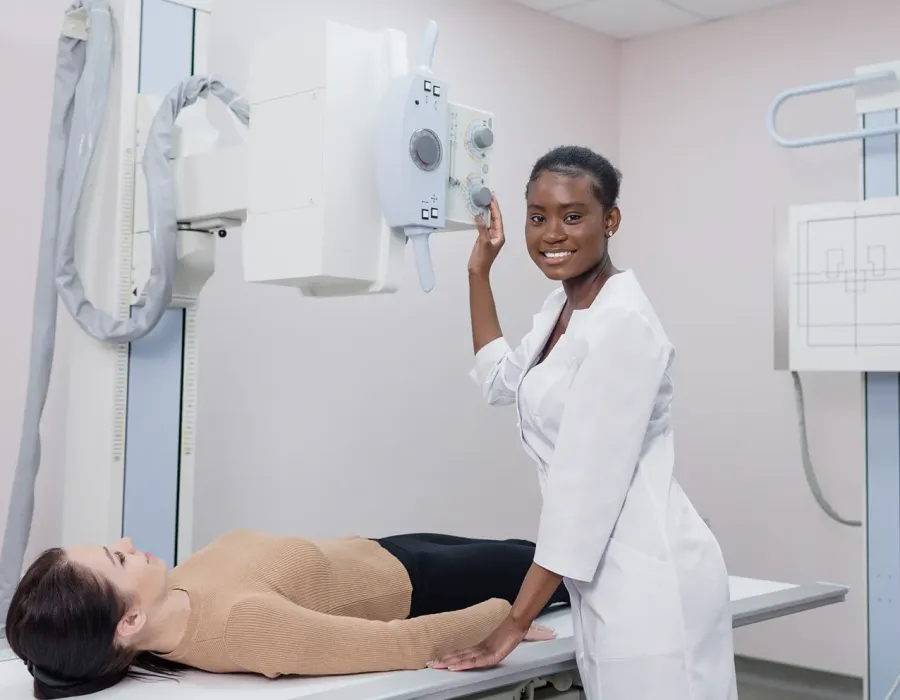
Radiologic technologists, often called x-ray techs or rad techs, produce the diagnostic images physicians use to evaluate injury and disease. According to the BLS, they typically follow physicians’ orders about which areas to image, prepare and shield patients, position the patient and the equipment to get the correct image, operate the computerized equipment, work with physicians to evaluate the images and determine whether more are needed and maintain patient records.
Hospitals employ about 60 percent of radiologic technologists, with physicians’ offices at 17 percent and outpatient care centers and medical and diagnostic laboratories at 7 percent each. Evening, weekend and overnight shifts are common in hospitals, where emergency departments may need images taken at any time.
Specializations for Radiologic Technologists
Your initial radiography credential is a starting point. As you progress through your career, you’ll have opportunities to move into specialized modalities through additional coursework, documented clinical experience and another certification exam. This is typically something you can do while you work full time.
Most professional development for radiological techs is administered by the ARRT, which currently offers certification exams for 12 different credentials. There are two ways in:
- The primary pathway is how most people earn their first ARRT credential. It requires completing an ARRT-approved educational program. Radiography, sonography, magnetic resonance, nuclear medicine, vascular sonography and radiation therapy are primary-pathway certification options. Individuals that do not hold at least one ARRT credential can gain credentialing through one of these pathways, which requires a specific program and degree.
- The postprimary pathway is for technologists already certified and registered with ARRT who want to add credentials beyond their primary credential(s). Bone densitometry, breast sonography, cardiac interventional radiography, computed tomography, magnetic resonance, mammography, vascular interventional radiography and vascular sonography may be obtained through the postprimary pathway. You prepare for these by gaining clinical experience, completing didactic education, and passing the certification exam.
- Two certifications are available via either the primary or postprimary pathway: MRI and vascular sonography.
Requirements differ by discipline and are updated periodically, so check the ARRT’s current structured education and clinical experience documents.
| Discipline | ARRT pathway | Where technologists work |
|---|---|---|
| Radiography | Primary | Hospitals, physicians’ offices, outpatient imaging |
| Computed tomography (CT) | Postprimary | Hospitals, outpatient imaging, diagnostic laboratories |
| Magnetic resonance imaging (MRI) | Primary or postprimary | Hospitals, diagnostic laboratories, physicians’ offices |
| Vascular sonography | Primary or postprimary | Hospitals, vascular labs, outpatient imaging |
| Cardiac interventional radiography | Postprimary | Hospital catheterization labs |
| Vascular interventional radiography | Postprimary | Hospital interventional suites |
| Bone densitometry | Postprimary | Outpatient imaging, physicians’ offices |
| Mammography | Postprimary | Breast centers, hospital imaging, mobile units |
| Breast sonography | Postprimary | Breast centers, hospital imaging |
| Radiation Therapy | Primary | Hospitals, physicians’ offices, outpatient imaging, cancer centers |
| Nuclear Medicine | Primary | Hospitals, physicians’ offices, outpatient imaging |
Pathway data: ARRT eligibility pathways. Employment settings: U.S. Bureau of Labor Statistics.
MRI technologist
MRI technologists operate scanners that use magnetic fields and radio waves to produce detailed images of soft tissue. They may administer contrast agents to patients in order to make certain structures easier to see during the test. There’s no ionizing radiation involved, so the safety focus shifts to screening patients, staff and anyone entering the room for metal and implanted devices.
Hospitals employ about 61 percent of MRI technologists, followed by medical and diagnostic laboratories at 17 percent, physicians’ offices at 14 percent and outpatient care centers at 3 percent.
Certification: MRI is one of two disciplines ARRT offers through both pathways. A certified radiographer would take the postprimary route, which means structured education, documented clinical experience and the MRI exam. Few states require licensure for MRI technologists, though employers typically prefer certified technologists even if it’s not required, according to the Bureau of Labor Statistics.
CT technologist
CT technologists operate scanners that capture a series of images from multiple angles and reconstruct them into cross-sectional views, giving physicians anatomical detail a single radiograph cannot provide.
CT techs can be found in similar settings as rad techs: hospitals, physicians’ offices, outpatient care centers and diagnostic laboratories.
Certification: CT is postprimary only. You’ll need to earn an ARRT credential in a supporting discipline, followed by structured education and documented clinical procedures.
Interventional radiography
Interventional technologists use real-time imaging to guide physicians through minimally invasive procedures, threading catheters and devices through blood vessels instead of opening the body surgically. It’s sterile-field work in a procedure suite, performed as part of a team.
The ARRT certifies interventional radiography in two different disciplines. Cardiac interventional radiography (CIR) covers procedures involving the heart and coronary vessels, such as catheterizations and stent placements. Vascular interventional radiography (VIR) covers procedures in blood vessels elsewhere in the body, including angiography and embolization.
Certification: Both CIR and VIR are postprimary credentials, requiring ARRT certification in a supporting discipline, structured education, documented clinical experience and the related certification exam.
Bone densitometry
Bone densitometry technologists perform DXA scans that measure bone mineral density, which physicians use to evaluate bone loss and fracture risk. The scans are quick and use a low dose of radiation. Precision matters, because results are often compared against a patient’s earlier scans.
The work is concentrated in outpatient imaging centers, physicians’ offices, women’s health practices and hospital imaging departments.
Certification: Bone densitometry is a postprimary credential built on an existing ARRT credential.
Mammography
Mammographers perform screening and diagnostic breast imaging using low-dose x-rays. Positioning and compression technique drive image quality more here than almost anywhere else in imaging. Good patient interaction skills are key.
Settings include hospital imaging departments, dedicated breast centers, outpatient imaging facilities and mobile mammography units.
Certification: Mammography is a postprimary credential requiring a supporting ARRT credential, structured education and documented clinical experience.
Breast sonography
Breast sonography uses ultrasound rather than x-ray, and that’s the core difference from mammography. Mammography passes low-dose radiation through the tissue to produce an image; breast sonography sends sound waves through it and builds the image from the returning echoes.
The two are often used together. Ultrasound is frequently ordered as a follow-up when a mammogram shows something that needs a closer look, for patients with dense breast tissue and to guide needle biopsies in real time.
Certification: Breast sonography is a postprimary credential. It requires an ARRT credential in an approved supporting discipline, structured education and documented clinical experience. Sonographers credentialed by ARDMS can also pursue it.
Frequently Asked Questions
Yes. The completion of an ARRT-recognized radiography program and an associate degree is the standard entry point into the field, with most states requiring licensure following credentialing.
Roughly two years of full-time study. Herzing’s program is 76 credits and takes an average of 24 months, with up to 57 approved credits transferable from prior college coursework.
No. Most imaging specializations are postprimary ARRT credentials that build on the certification a technologist already holds. The requirements are structured education, documented clinical experience and a discipline exam rather than another degree.
A radiologist is a physician who interprets medical images and makes the diagnosis. A radiologic technologist performs the exam: positioning the patient, operating the equipment, capturing the images and working with the physician to determine whether additional images are needed.
ARRT currently offers certification exams for 12 different credentials. Eight of those disciplines are available through the postprimary pathway, which is the route open to technologists who are already certified and registered.
One Degree, Many Directions
Your radiologic technology degree is the passport to a wide range of specialties that can help physicians treat and care for patients. Whether you want to work in a busy emergency department, support women’s healthcare, or be the eyes of a surgeon placing a catheter, there’s a pathway you can pursue after earning your AS in Radiologic Technology.
Live in Florida, Tennessee or Texas? Learn more about the Associate of Science in Radiologic Technology at a Herzing University campus near you, including Orlando, Tampa, Clarksville and Dallas.
Explore our associate degree in radiologic technology program
* BLS pay estimates calculate the median annual wage for various occupations. Per the BLS the median wage for an occupation is: "The wage at which half of the workers in the occupation earned more than that amount, and half earned less. Median wage data are from the BLS Occupational Employment and Wage Statistics survey." Bureau of Labor Statistics (BLS), U.S. Department of Labor, Occupational Outlook Handbook 2025. BLS median wage estimates do not represent entry-level wages and/or salaries. Multiple factors, including prior experience, age, geographic market in which you want to work, and degree level and field, will affect career outcomes, including starting salary and earnings as an experienced employee. Herzing neither represents that its graduates will earn the median salaries calculated by BLS for a particular job nor guarantees that graduation from its program will result in a job, promotion, particular wage or salary, or other career growth.