
Latest
Applying to Herzing’s AS in Radiologic Technology Program

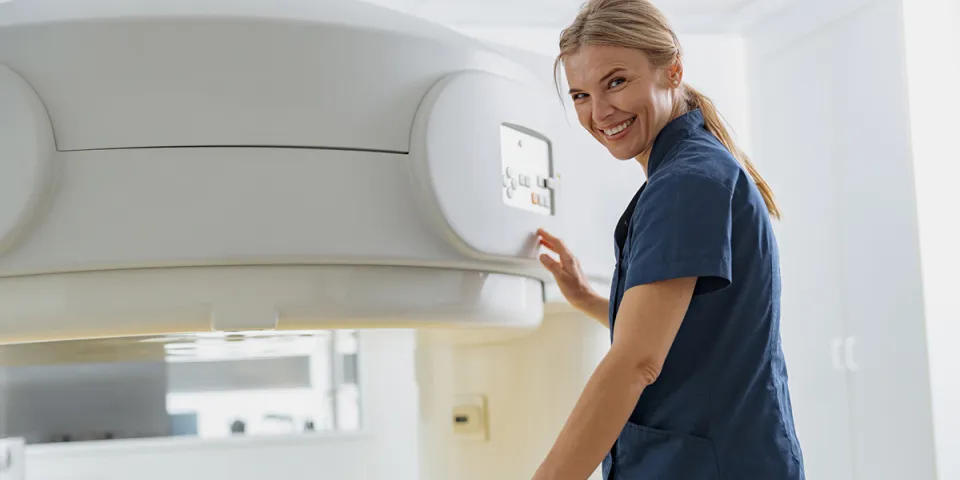
A radiologic technology degree can open the door to a rewarding career in healthcare. As a rad tech, you'll work with cutting-edge imaging technology, support physicians as they work toward a diagnosis and care for patients during their exam.
At Herzing, applying to our Associate of Science (AS) in Radiologic Technology degree program is designed to be a streamlined process. You’ll have support from an advisor every step of the way. However, you can make the process even more straightforward with some organization beforehand—for example, by considering your college readiness and gathering information about your prior education.
You can also read through this guide. It explains what you'll need to apply to our rad tech program and walks through the process step by step.
What Do Rad Techs Do, and Why Should I Earn a Rad Tech Degree?
Radiologic technologists, often called rad techs or x-ray techs, are healthcare professionals who perform diagnostic imaging exams. According to the American Society of Radiologic Technologists (ASRT), rad techs "practice in hospitals, clinics and physician's offices, and in many clinical specialties, from prenatal care to orthopedics."
On a typical day, a rad tech may do the following, per the U.S. Bureau of Labor Statistics (BLS):
- Prepare patients for procedures, including taking a medical history and shielding exposed areas
- Position the patient and the equipment to capture the correct image
- Operate computerized imaging equipment
- Work with physicians to evaluate images and decide whether additional images are needed
- Keep detailed patient records
Students choose radiologic technology for a few common reasons:
- Specialization. Radiography is a common starting point. Once you're a registered technologist, you can pursue additional credentials across a range of imaging technologies and medical specialties (see the table below).
- Job growth. The BLS projects employment of radiologic and MRI technologists to grow 5% from 2025 to 2035, faster than the average for all occupations, with about 15,300 openings each year.
- Salary potential. The average annual wage for radiologic technologists and technicians was $83,840 in May 2025, according to the BLS.
- A foundation for future study. An associate degree can set you up to complete a bachelor's degree later. For example, if you decide you want to move into management, you could transfer credit from your AS degree to our BS in Health Sciences, which accepts up to 90 approved transfer credits.
ARRT Credential Options for Registered Technologists
X-rays are only one of the imaging functions rad techs can perform. The American Registry of Radiologic Technologists (ARRT) offers credentials in 12 active disciplines. Some of these are primary pathway credentials: that is, you earn them through formal education in that discipline. Post-primary credentials build on a credential you already hold, meaning you can pursue them as your career grows by taking professional development classes.
| Credential (ARRT Code) | Pathway | Purpose |
|---|---|---|
| Radiography (R) | Primary (AS in Rad Tech qualifies) | Produce diagnostic x-ray images of bones, organs and tissues |
| Magnetic Resonance Imaging (MR) | Primary or post-primary | Use magnetic fields and radio waves to create detailed images of soft tissue |
| Nuclear Medicine Technology (N) | Primary (separate degree required) | Use radioactive materials to image how organs function and help diagnose disease |
| Radiation Therapy (T) | Primary (separate degree required) | Deliver radiation treatments for cancer and other diseases |
| Sonography (S) | Primary (separate degree required) | Use high-frequency sound waves to image organs, tissues and blood flow |
| Vascular Sonography (VS) | Primary or post-primary | Use ultrasound to evaluate blood vessels and circulation |
| Computed Tomography (CT) | Post-primary | Create cross-sectional images of the body with specialized x-ray equipment |
| Mammography (M) | Post-primary | Perform breast imaging for cancer screening and diagnosis |
| Breast Sonography (BS) | Post-primary | Use ultrasound to evaluate breast tissue |
| Bone Densitometry (BD) | Post-primary | Measure bone density to help assess conditions such as osteoporosis |
| Cardiac Interventional Radiography (CI) | Post-primary | Assist with image-guided procedures involving the heart |
| Vascular Interventional Radiography (VI) | Post-primary | Assist with image-guided, minimally invasive procedures involving the blood vessels |
Our curriculum is designed to prepare you for the national registry exam offered by the ARRT, which leads to the Registered Technologist in Radiography, or R.T.(R), credential. Once you’ve earned your certification, you’ll be set up to pursue any of the post-primary options listed above, depending on where your career takes you.
Admission Requirements for Herzing's AS in Radiologic Technology Program
Our AS in Radiologic Technology is currently available at Herzing campuses in Dallas, Tex., Orlando, Fla., Tampa, Fla. and Clarksville, Tenn.
The program combines online general education classes with hands-on training in our labs and more than 700 hours of supervised clinical experience in local healthcare settings. Most students finish in about 24 months.
What You'll Need to Apply
- A high school diploma, GED or equivalent
- Proof that you're ready for college-level courses, through prior ACT/SAT scores, completion of prior college credit or additional entrance testing
- Completion of drug testing, immunization and health checks, plus acknowledgment of select policy statements, since the program includes direct patient contact in clinical settings
- The time, personal commitment and professional attitude to succeed in the program
- An interview with a Herzing admissions advisor and a completed enrollment application
Once you're enrolled, you'll need to earn a C (70%) or better in Anatomy and Physiology I and II, including both labs, to continue in the program. Full details are listed on each campus program page.
Transferring Credit
If you've taken college courses before, you may be able to apply them toward your degree. You can transfer up to 57 approved credits from prior college coursework into the AS in Radiologic Technology program, which can reduce the number of general education classes you need to complete. We can also help you explore credit for training, work or military experience.
To start a transfer credit review, submit your unofficial transcripts to your admissions team when you enroll. Transfer credits are officially posted to your account once we receive your official transcripts.
The HESI Entrance Exam
Depending on your academic background, you may need to take the HESI Admission Assessment (A2) as part of the application process. Many health professions programs, including radiologic technology programs, use it to gauge how ready you are for the coursework ahead.
If your prior ACT/SAT scores or college credits already show you're ready for college-level work, you may be able to meet the entrance testing requirement that way instead.
Applying to Herzing's AS in RT: Step-by-Step Overview
Herzing offers rolling admissions for the AS in Radiologic Technology, so there's no application deadline to work around. Here's how the process typically unfolds:
- Meet with an admissions advisor. Schedule a meeting on campus or virtually to talk through your career goals, class start dates and the campus that fits you best.
- Submit your application and transcripts. Complete your enrollment application and send transcripts from your high school and any colleges you've attended, so we can review you for transfer credit.
- Complete any required entrance exams. If you don't already meet the college readiness requirement through ACT/SAT scores or prior college credit, you'll finish your entrance testing.
- Build your funding plan. Work with your Financial Aid Advisor to put together a comprehensive funding plan, then pay your enrollment fee.
- Prepare for class. Once you're accepted, you'll be registered into the appropriate classes and can get ready for your first term.
- Complete your health and clinical checks. Take care of drug testing and immunization and health checks, and acknowledge the required policy statements.
Picture Yourself as a Herzing Radiologic Technology Student
Find out more about earning the AS in Radiologic Technology at a campus near you. Or, if you're ready to take the next step, get in touch with an admissions advisor to start your application.
Frequently Asked Questions
You'll need a high school diploma, GED or equivalent, proof of college readiness, and completed drug testing, immunization and health checks. You'll also interview with an admissions advisor and complete an enrollment application.
It depends on your background. Prior ACT/SAT scores or college credit may show that you're ready for college-level courses. If not, you'll complete additional entrance testing, such as the HESI Admission Assessment.
Yes. You can transfer up to 57 approved credits from prior college coursework, which can shorten the number of general education classes you need to take.
Most students complete the AS in Radiologic Technology in about 24 months.
The program is currently available at our campuses in Dallas, Tex.; Orlando, Fla.; Tampa, Fla.; and Clarksville, Tenn.
Yes. Our curriculum is designed to prepare you for the national registry exam offered by the ARRT, so you can earn the R.T.(R) credential.
Learn more about our AS in Radiologic Technology
Herzing University is institutionally accredited by the Higher Learning Commission (hlcommission.org), an institutional accreditor recognized by the U.S. Department of Education.








Subscribe to our Newsletter
Get the latest news you need to know, from study hacks to interview tips to career advancement. Have it delivered right to your inbox biweekly.