
Latest
Radiologic Tech Clinicals: Hours, Rotations, and What to Expect


Most accredited radiologic technologist programs combine classroom learning with supervised clinical rotations in hospitals and outpatient imaging settings. Each program sets its own number of clinical hours, but every student working toward certification from the American Registry of Radiologic Technologists (ARRT) must demonstrate competence in a defined list of patient care and imaging procedures before graduating.
Earning your degree as a Registered Technologist (R.T.) in Radiology is no easy task. By achieving it, you can prepare for a career as a healthcare professional, performing life-changing assessments through advanced medical technology. After you’ve navigated your initial assignment and exams to lay the groundwork, it’s finally time for one of the most exciting and informative chapters of your education: clinicals!
Clinicals allow radiologic technology students to observe, understand, practice and become competent in an environment that prepares them for real-life experiences as Registered Technologists.
In this post, we’ll cover how many clinical hours rad tech programs require, the rotations and settings you can expect, the ARRT competencies you’ll work toward, and how clinicals work at Herzing University’s Radiologic Technology program. We’ll also walk through what to expect on your first day and tips to help you prepare.
What Clinical Experience Do Rad Tech Programs Require?
Clinical education in a radiologic technology program is built around competency, not just time on site. Here’s a quick look at the main pieces.
| Requirement | What to expect |
|---|---|
| Clinical hours | Set by each program and sometimes by the state. Herzing’s program includes 800+ clinical contact hours across six clinical education courses. |
| ARRT competencies | 10 mandatory general patient care procedures 36 mandatory imaging procedures 15 elective imaging procedures chosen from a list of 34 |
| Rotation areas | General diagnostic imaging (chest, extremities, spine, pelvis, abdomen), fluoroscopy, mobile (portable) exams, surgical C-arm, trauma, pediatric and geriatric patients |
| Clinical settings | Hospital imaging departments, emergency departments, operating rooms, outpatient imaging centers and clinics |
| Supervision | Competencies are observed and verified in person by the program director or a designee |
| Format | In person only. Clinical requirements can’t be completed remotely. |
ARRT competency numbers reflect the 2022 Radiography Didactic and Clinical Competency Requirements. Updated requirements take effect March 1, 2027.
How Many Clinical Hours Do Rad Tech Programs Require?
There’s no single national number. ARRT measures clinical readiness by the procedures you can perform competently, so each program decides how many hours it takes to get students there, and some states add their own rules. That’s why it helps to ask any program you’re considering for its clinical hours in contact hours rather than a general description. At Herzing, the curriculum includes more than 800 clinical contact hours across six clinical education courses, plus 150 contact hours in on-campus procedure labs.
What Rotations Do Rad Tech Students Complete?
Because ARRT competencies cover a wide range of exams, programs typically schedule clinical time so you can work in several areas, such as:
- General diagnostic radiography: Routine X-rays of the chest, upper and lower extremities, spine, pelvis and abdomen
- Fluoroscopy: Real-time imaging studies such as upper GI series and contrast enemas
- Mobile (portable) radiography: Bedside exams for patients who can’t be moved to the imaging department
- Surgical and C-arm imaging: Imaging in the operating room, including work around a sterile field
- Trauma: Adjusting positioning and equipment for injured patients while monitoring their condition
- Pediatric and geriatric patients: Adapting exams for young children and older adults
The specific rotations, order and schedule depend on your program and its clinical sites.
Where Do Rad Tech Clinicals Take Place?
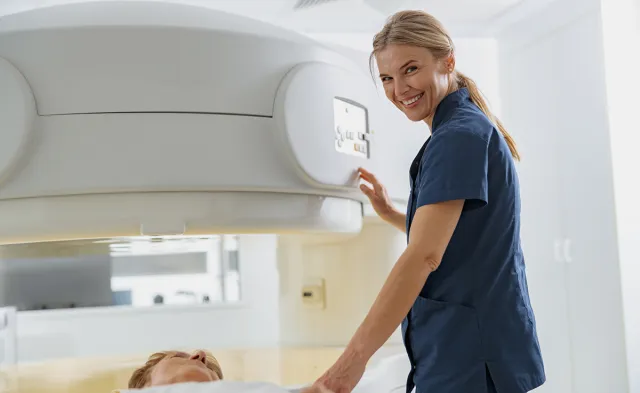
Clinicals take place at healthcare facilities your program partners with, where radiologic technologists already work. Depending on the site, you may spend time in hospital imaging departments, emergency departments, operating rooms and procedural suites, as well as outpatient imaging centers and clinics. Herzing’s clinical education courses provide supervised experience in real clinic and hospital settings.
What ARRT Clinical Competencies Do You Need?
To be eligible for ARRT certification in radiography, you need to show you can perform a defined set of procedures independently, consistently and effectively. Under ARRT’s current 2022 requirements, that includes 10 mandatory general patient care procedures, 36 mandatory imaging procedures and 15 elective imaging procedures chosen from a list of 34. At least one elective has to come from the head section and two from fluoroscopy studies. ARRT allows up to 10 imaging procedures to be simulated on a live person without activating the X-ray beam.
ARRT has approved updated requirements that take effect March 1, 2027. They call for 35 mandatory and 17 elective imaging procedures. Students who complete their program in 2027 or 2028 may use either set of requirements, and those who finish after February 28, 2029, will use the 2027 version. Your program will tell you which list applies to you.
How Are Clinical Competencies Supervised?
You’ll work alongside registered technologists at your clinical site, and your competencies are verified in person. ARRT’s requirements state that the program director or a designee must directly observe you performing each competency, and you must be physically present with the patient and equipment. Remote scanning and remote observation don’t count toward ARRT clinical requirements.
How Clinicals Work In Herzing’s Radiologic Technology Program
Herzing’s Associate of Science in Radiologic Technology is a 76-credit program that takes an average of 24 months to complete. It’s offered on campus in Clarksville, Tennessee, Dallas, Texas, Orlando, Florida and Tampa, Florida, with general education courses completed online.
The program moves through three stages. You start with academic coursework in topics like medical terminology, anatomy and physiology, patient care and principles of radiography. On-campus labs then let you practice procedures through in-person demonstrations before you advance into a real clinical environment. Finally, six clinical education courses pair supervised experience in clinic and hospital settings with competency evaluations, so you build skills in sequence as you work toward the competencies ARRT requires.
Once you earn your associate degree, you’ll be eligible to take the national registry exam offered by ARRT and apply for state licensure. Herzing University is accredited by the Higher Learning Commission, an institutional accreditation agency recognized by the U.S. Department of Education.
What To Expect On Your First Day
- Introductions: Like all the other “first days” that you’ve conquered before, your first day of X-ray clinicals will begin with introductions to your peers, faculty, technologist, clinical staff and equipment. You’ll meet with your team who will show you around the X-ray facility and give you an overview of your facility's specific policies and procedures. This is also when you’ll get up close and personal with the digital imaging systems you’ll be using.
- Shadow Opportunities: During your initial visit, you will be assigned to a specific area within the radiology department within the facility to simultaneously observe and assist the experienced R.T.s with procedures, positioning, techniques and general protocols. Supporting professionals with their day-to-day tasks will give you the confidence to flourish once you enter the field. You'll also observe how to best interact with patients through a variety of often difficult situations, picking up insightful tips for providing well-rounded, high-quality care.
- Training: The goal of clinicals is to ensure that you are as prepared as possible to serve your community and succeed in your career. Shadowing is a valuable resource, providing valuable experiences for future Radiologic Technologists. However, the most effective educational experience comes when shadow opportunities are supplemented by training. On your first day and throughout your entire clinical experience, you’ll be trained in proper safety protocols, record keeping, patient-facing procedures and exam prep. To get the most out of your experience, take your training seriously, and treat your practice procedures with the same seriousness that one would treat a real patient procedure.
Tips For Success In Your Rad Tech Program
To start your clinicals off right, you should prepare yourself for the first day. Use these tips to help you set yourself up for success:
- Make Connections: Make positive first impressions by introducing yourself to your peers and instructors, including shaking their hands and being respectful. Creating connections will ensure that you’re getting the most out of this valuable experience and could lead to exciting opportunities down the road.
- Manage Your Time Efficiently: Being able to effectively manage your time will be a major key to success in clinicals. Your coursework is already time-consuming; by managing your time, you can make the seemingly impossible transition of adding clinicals to your schedule possible. Become a skilled time manager by focusing on prioritization, utilizing time management tools, and minimizing distractions.
- Track Your Competencies: Most programs give you a log or tracking system for the ARRT competencies you complete. Update it after each clinical shift, and ask your clinical instructor which exams you can work toward next so you can plan your progress through each rotation.
- Be Confident. Be Curious: Throughout this entire journey, remind yourself that you deserve to be here. You are capable of not only completing these clinicals but crushing them! There is strength in asking for help or wanting to learn more about something you’re admittedly unfamiliar with—don’t be afraid to be inquisitive. Be curious about what’s going on around you and be open to collaborating with others. Carrying yourself with confidence will help make you the best radiologic technologist you can be.
With all this in mind, you’re more than prepared to thrive during your first day of clinicals and beyond. The skills you’ll acquire during this transformative time will support you throughout your entire career, so be sure to make it count. If you are not enrolled in a Radiologic Technology program and are interested in joining this rewarding career path, learn more about Herzing University’s selection of available programs today.
Frequently Asked Questions About Rad Tech Clinicals
Programs require supervised clinical rotations at hospitals and outpatient imaging facilities, where you perform real exams on patients under the guidance of registered technologists. During clinicals, you work toward the competencies ARRT requires for certification, including general patient care procedures and a set of mandatory and elective imaging procedures across areas like general radiography, fluoroscopy, mobile and surgical imaging and trauma. Programs must be accredited by an agency ARRT recognizes for graduates to be eligible for the ARRT exam.
Yes. Clinicals are where you complete the clinical competency requirements that are part of ARRT’s education requirements. Your program director verifies that you’ve met them when you apply to take the national registry exam.
No. ARRT requires you to be physically present with the patient and equipment, and remote scanning doesn’t count. At Herzing, you can complete general education courses online, while labs and clinicals take place in person.
Clinicals are part of your coursework, so they’re typically unpaid. They’re designed as supervised learning experiences rather than jobs. Often clinical rotation experiences lead to a full-time position following graduation.
Clinicals start after you’ve spent a semester in rad tech concentrated courses to build a foundation in the classroom and lab. In Herzing’s Radiologic Technology program, you start with academic coursework, practice procedures in on-campus labs and then move into supervised clinical education courses at clinic and hospital sites.
Explore our Radiologic Technology Program
* BLS pay estimates calculate the median annual wage for various occupations. Per the BLS the median wage for an occupation is: "The wage at which half of the workers in the occupation earned more than that amount, and half earned less. Median wage data are from the BLS Occupational Employment and Wage Statistics survey." Bureau of Labor Statistics (BLS), U.S. Department of Labor, Occupational Outlook Handbook 2025. BLS median wage estimates do not represent entry-level wages and/or salaries. Multiple factors, including prior experience, age, geographic market in which you want to work, and degree level and field, will affect career outcomes, including starting salary and earnings as an experienced employee. Herzing neither represents that its graduates will earn the median salaries calculated by BLS for a particular job nor guarantees that graduation from its program will result in a job, promotion, particular wage or salary, or other career growth.






Subscribe to our Newsletter
Get the latest news you need to know, from study hacks to interview tips to career advancement. Have it delivered right to your inbox biweekly.